

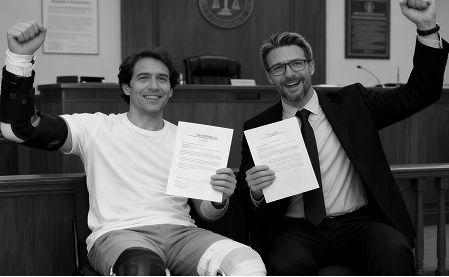

Many people aren’t sure whether they have a personal injury case after suffering an injury. The best way to find out is by speaking with a personal injury lawyer near you. Our team will break down what it means to have a personal injury case and what you need to establish to win yours.
Grounds for a Personal Injury Case
While many personal injury cases are based on negligence, there are several different grounds that you could build an injury case on.
Negligence
Negligence is the most common ground for personal injury claims. Negligence occurs when someone fails to act with the level of care that a reasonably prudent person would have exercised in the same situation. Essentially, if a person acts carelessly, they are negligent.
Examples of negligence include:
- A driver texting while driving and causing a crash
- A store failing to clean up a spill that causes a customer to fall
- A doctor misdiagnosing a condition due to careless examination
- An airplane maintenance crew failing to ensure that everything is calibrated correctly
To succeed on the ground of negligence, a plaintiff typically must prove four elements: duty, breach, causation, and damages.
Strict Liability
Strict liability applies when a defendant is held responsible for harm regardless of intent or negligence. Strict liability can apply in product liability and dog bite cases.
The key in strict liability is that the plaintiff does not need to prove fault; they only need to prove that the defendant’s action or product caused the injury.
Intentional Misconduct (Intentional Torts)
Some personal injury cases arise from deliberate actions rather than accidents. Intentional torts involve assault and battery, false imprisonment, intentional infliction of emotional distress, and fraud or deceit that causes harm.
These cases can lead to civil liability, separate from any criminal charges the defendant might face.
Key Elements of a Personal Injury Case
Typically, to have a valid personal injury case, another party’s negligence or actions need to have caused or contributed to your accident or injury. The key elements of a personal injury case are:
Duty of Care
This is the legal obligation one person has to avoid causing harm to another. Duty of care arises when the law recognizes a relationship between two parties that requires one to act (or refrain from acting) in a certain way toward the other.
Examples of duties of care include:
- A driver has a duty to operate their vehicle safely and follow traffic laws.
- A property owner has a duty to maintain safe conditions on their premises.
- A manufacturer has a duty to ensure that their products are not dangerously defective.
The first step in evaluating a personal injury claim is determining whether the defendant owed you a duty of care in this situation.
Breach of Duty
Once we have established duty of care, we must show that the defendant breached their duty to you. A breach occurs when a person or entity fails to meet the expected standard of care under the circumstances.
A defendant can breach their duty of care by:
- Running a red light
- Neglecting to clean up a spilled liquid
- Failing to diagnose a condition that a competent physician would have identified
We can establish a breach of duty:
- Through evidence such as surveillance footage, eyewitness testimony, or expert analysis
- By comparing the defendant’s actions to what a “reasonable person” would have done in the same situation
Causation
This element connects the breach of duty directly to the injury suffered. There are two types of causation that we could apply in your case:
- Actual Cause (“Cause in Fact”): The harm would not have occurred “but for” the defendant’s actions.
- Proximate Cause: The harm was a foreseeable result of the defendant’s behavior.
Damages
Even if the other elements are met, there must be harm to pursue a personal injury claim. There are two types of damages commonly recoverable in injury claims:
- Economic damages: Medical bills (past and future), lost wages and earning capacity, property damage
- Non-economic damages: Pain and suffering, emotional distress, development of mental illness, loss of enjoyment of life, loss of consortium
To prove your damages, we would gather:
- Medical records
- Pay stubs or employment records
- Expert testimony (e.g., for future medical needs or economic loss)
- Journals, photos, or therapy records to illustrate non-economic harm
Without real, documented damages, a personal injury case will not hold up, even if fault is clear.
Examples
You must demonstrate all of these elements, or you don’t have a case. Here are a few examples where someone acted negligently but won’t be liable for damages:
- A doctor misses a tumor on a scan, but diagnoses it a month later, and it does not grow or metastasize. You don’t have a case.
- A truck driver falls asleep at the wheel but wakes up before hitting any other vehicles. There wouldn’t be a valid case, even though the driver was negligent.
Examples of when you might have a case:
- A pilot flies while fatigued and causes a deadly crash. Because the pilot’s negligence caused the crash, you may have a valid case.
- You suffer a spinal cord injury after being sideswiped by a distracted truck driver. You may be able to sue the driver and their employer.
What Is Liability?
Liability means responsibility for something, especially when it comes to legal or financial consequences. If someone is “liable,” it means they’re on the hook for it.
While this could be the person who caused your accident or injury, it isn’t always limited to them. For example, if a truck driver’s negligence caused your accident, the trucking company is likely also liable under vicarious liability laws.
Types of Personal Injury Cases
Our team handles all types of serious and catastrophic injury cases, including:
- Motor vehicle accidents (truck, car, motorcycle, pedestrian, bicycle)
- Workplace accidents (e.g., construction)
- Aviation accidents
- Train crashes
- Premises liability (slips and falls, dog bites)
- Medical malpractice
Do I Need a Lawyer for a Personal Injury Case?
Legally, you don’t need a lawyer. But if you go it alone, you must handle everything yourself — gathering evidence, paying expenses, negotiating with insurers, and more.
With us, we handle:
- Evidence collection
- Valuing your damages
- Identifying liable parties
- Negotiating with insurers
- Working with experts
- Preparing for trial
- Representing you in court
We work on contingency — no upfront cost, and you only pay if we win.
Call Today to See if You Have a Personal Injury Case
With over 100 years of combined experience, a 99% success rate, and more than $1 billion recovered, our Hispanic-owned firm fights and wins the toughest cases. Let Aviles Law Firm determine if you have a case and fight for the compensation you deserve.
Contact us today and take the first step toward justice.